Weeks in Review
Weeks to Publication
Madang: Journal of Contextual Theology
Open access, Peer Reviewed
pISSN 1738-3196
eISSN 3091-7824
Sunyoung Cho
Ph. D. candidate (Systematic Theology), Dept. of Christian Studies, Graduate School of Liberal Arts of Ewha Womans University, Seoul, Korea
Correspondence to Sunyoung Cho, Email: sunyoungcho@ewha.ac.kr
Volume 45, 105-122, June 2026.
Madang: Journal of Contextual Theology 2026;45:105-122. https://doi.org/10.58302/Madang.2026.45.8
Received on May 13, 2026, Revised on June 16, 2026, Accepted on June 16, 2026, Published on June 30, 2026.
Copyright © 2026 Author(s).
This is an Open Access article distributed under the terms of the Creative Commons CC BY 4.0 license (https://creativecommons.org/licenses/by/4.0/).

Kim Ki-chang, The Life of Jesus, Korean Indigenization Theology, Korean Contextual Theology, Religious Synthesis
The Bible states, “Jesus Christ is the same yesterday and today and for ever” (Heb. 13:8). While the ontological essence of Jesus Christ remains constant in Christian faith, the cultural “garments” he wears—the visual and theological lenses through which he is perceived—have shifted across every time and space. Throughout the centuries, Jesus has been reimagined to meet the existential needs of diverse peoples. In the Korean context, this process of “re-clothing” was necessitated by the tragic history of Japanese colonial occupation and the trauma of the Korean War. This historical imperative led to the emergence of a distinctively Korean understanding of Jesus—one that sought to move beyond the Western-centric theology introduced by missionaries in the late 19th century and transcend foreign frameworks to speak directly to the Korean soul.
The artist Kim Ki-chang (1913–2001) gave this conceptual shift a literal and vivid form between 1952 and 1953, during the height of the Korean War. In his 30-piece series, The Life of Jesus, Christ is portrayed not as a foreign figure but as a Korean scholar-sage of the Joseon Dynasty, complete with the gat (traditional hat) and dopo (scholar’s robe). Previous scholarship on Kim’s The Life of Jesus has largely been circumscribed to the realm of Korean art history, focusing either on its position within modern Korean painting or on its development as a form of Christian iconography.1 Within theological circles, research remains sparse and seldom moves beyond identifying the series as a basic case study of cultural indigenization based on its traditional Joseon-era motifs.2 A notable, more specialized exception exists in the field of biblical studies, where three of Kim’s paintings—The Flight into Egypt, The Baptism by John, and The Walking on Water—have been utilized for aesthetic biblical exegesis to interpret scriptural narratives.3 However, all these inquiries often stop at describing localized interpretations or artistic adaptations, failing to connect Kim’s visual narrative with the broader, systematic indigenization theology of Korean Christianity.
In this regard, this study contends that Kim’s work represents a precursive manifestation of the indigenization theology that would formally crystallize within Korean Christianity a decade later in the 1960s. Specifically, this paper explores The Life of Jesus in direct dialogue with the indigenization theology of Korean Christianity, investigating how the figure of Jesus was perceived and internalized within the Korean consciousness. By analyzing the ways in which Korean socio-cultural, historical-existential, and theological landscapes were projected onto Kim’s work, this study intends to demonstrate this series functioned as a precursive theological manifestation, anticipating the formal indigenization theology systematized by Korean theologians—such as Sung-bum Yoon and Tong-shik Ryu—by nearly a decade. To substantiate this claim, the paper first provides a biographical overview of the artist and the series, followed by a multi-layered analysis of the work’s indigenization aspects across the dimensions of traditional culture, history, and theology.
Kim Ki-chang’s life can be characterized by a sensory exile that ironically paved the way for his unique spiritual and artistic vision. Born in Seoul in 1913 under the Japanese colonial rule, he lost his hearing at age seven due to typhoid fever. Kim reflected on this trauma as a divine calling, stating “I was thus chosen by God upon birth. If not, how could a fever visit me to make this seven-year-old boy deaf? I was confined within a quiet world of solitude shut out from the myriad sounds of the outside world…But I took to find a way out of that estrangement. I was to become an artist and a painter.”4 This world of silence facilitated a unique visual hermeneutic, functioning as a kind of “spiritual sight,” which enabled him to bypass external doctrines and develop an intuitive way of witnessing reality.
In 1930, Kim became a disciple of Eun-ho Kim, the last royal portrait artist of the Joseon Dynasty. His extraordinary talent was immediate; he debuted at the 10th Joseon Art Exhibition in 1931 and earned five consecutive awards, establishing himself as a preeminent artist. However, his early career during the late colonial period was marred by his participation in pro-Japanese propaganda art. He produced militaristic paintings, notably Jeokjin Yukbak (Close Combat with the Enemy, 1944), which led to his inclusion in the Dictionary of Pro-Japanese Collaborators after Korea’s liberation.5 While some scholars such as Byeong-sik Choi have argued—upon acknowledging these historical facts—that his pro-Japanese activities were marginal, circumstantial exceptions compelled by the mandatory nature of colonial-era exhibitions,6 this study proceeds with the following analysis with a critical awareness of Kim’s history of pro-Japanese collaboration.
A pivotal turning point was his marriage to Nae-hyun Park in 1946. Through Park’s unwavering devotion and linguistic training, he learned to speak verbally, breaking his social isolation and finding a voice in the public sphere for the first time. When the Korean War broke out in 1950, the family sought refuge in Gunsan, Park’s hometown. In this crucible of national tragedy and personal displacement, Kim produced his magnum opus, The Life of Jesus, born from a search for hope amidst the ruins of war. Following the 1950s, Kim’s artistic world continued to evolve, transitioning from traditional themes to Blue-Green Landscapes and the folk-inspired Babo Sansu (literally meaning idiot landscapes), eventually embracing abstract expressionism.
In his later years, he practiced a philosophy of philanthropy, founding the Korea Welfare Association for the Deaf in 1979 and the Chungeum Rehabilitation Center in 1985. He believed that art was not merely for aesthetic pleasure but for social responsibility, stating: “Art is the pursuit of beauty, but ultimate beauty is found in serving others…If an artist lives only for art, he may degrade into a painter of vanity, but when service is added, he becomes a true artist.”7 This integration of personal suffering, artistic mastery, and social service, set against the turbulent history of modern Korea, serves to position Kim not just as a painter, but as a “theologian with a brush” who transformed his lifelong silence into a resonant voice for the Divine.
The genesis of The Life of Jesus lies in the darkest chapter of modern Korean history—the Korean War. In 1950, as the nation was ravaged by conflict, Kim fled with his family to his wife’s hometown of Gunsan. Amidst the poverty and harsh conditions of this displacement, where even basic art supplies were a luxury, Kim abandoned all other concerns to devote himself entirely to this series.
A primary catalyst for this undertaking was a conversation with Anderson K. Jenson, an American missionary and close friend. Kim later recalled the encouragement he received from Jensen, who remarked, “Jesus was not born for just one nation. As the Savior of all humanity, different nations can depict Him in a way that reflects their own identity to strengthen their faith.”8 Resonating with the idea that Christianity must take root within the Korean cultural framework to find its genuine indigenous expression, Kim embarked on creating a uniquely Joseon-era portrayal of Jesus, depicted wearing a gat (hat) and dopo (scholar’s robe).
Kim further identified a parallel between the biblical narrative and the Korean experience. He saw a resonance between the suffering of the Jewish people under Roman tyranny and the tragedies faced by Koreans during the Korean War. For Kim, the Jewish yearning for a Messiah mirrored his own desperate hope for a Savior who could offer a message of redemption to a wartorn nation. This spiritual intensity led to mystical experiences; he became so immersed in the work that he claimed to see the body of Jesus in both his dreams and broad daylight:
“One night, in my dream, I carried the dead body of Jesus Christ down into an underground tomb. Unable to bring myself to leave Him there, I carried Him back up to the surface, weeping bitterly, until I was shaken awake. It was my wife. In waking reality, tears were pouring from my eyes like rain. Perhaps this dream—and these tears—were an act of repentance for the tragic fratricide of our nation and the many wrongdoings of my own life.”9
In this confession, Kim interpreted his tears as an act of repentance not only for the national tragedy but also for the “various wrongdoings” of his past. While it is impossible to determine whether this repentance encompassed his pro-Japanese collaboration, this admission suggests a profound reckoning. Prior to this series, Kim’s early works heavily relied on Japaneseinfluenced sepil chaesaekhwa (fine-brush polychrome painting). However, art historians note a radical stylistic shift that roughly coincides with his confession. According to Byeongsik Choi, after 1945, Kim gradually began to discard the Japanese techniques learned from his early mentor, completely breaking away from the colonial style by 1952.10 Corroborating this, Youngok Sim observes that the series holds unparalleled artistic value because it revives traditional Korean aesthetics, utilizing sumuk-damchae (ink and light color), samwonbeop (traditional multi-point perspective), and the intentional use of yeobaek (empty space).11 Kim’s departure from the colonial aesthetic toward a distinctly Korean style is highly significant. While this stylistic shift and the depiction of a suffering Jesus do not erase the facts of his colonial collaboration, they may be interpreted as an artistic wrestling with his historical guilt. In this sense, this study understands this series as a visual manifestation of an artist grappling with his past compromises while attempting to share in the agony of the Korean people.
Between 1952 and 1953, Kim completed 29 paintings depicting the life of Christ as if he had lived in Korea. These works were first exhibited in Seoul in April 1954, shortly after the Korean War armistice. Following the first exhibition, a German priest noted the absence of the Resurrection and encouraged Kim to add it to the narrative. Three years later, Kim completed The Resurrection, bringing the series to a total of 30 pieces.12
To analyze Kim’s The Life of Jesus is to witness a profound dialogue between a universal faith and a specific culture. This series is not merely a collection of illustrations; it is a visual reconstruction of the Gospel through the lens of the Korean soul. By dismantling the “Westernized” image of Christ that had dominated the Korean religious imagination for decades, Kim presents a Savior who is intimately connected to the history, aesthetics, and struggles of the Korean people.
To analyze these 30 works systematically, this study divided them into four distinct narrative acts; (1) the birth and growth of Jesus, (2) the public ministry and teachings of Jesus, (3) the passion and death of Jesus, and (4) the resurrection and ascension of Jesus.
The first movement covers the nativity and childhood of Jesus, where Kim focuses on the localization of its cultural and spatial settings. In The Birth of Jesus (Figure 1), the savior is born not in a Judeo-Palestinian stable, but in a traditional Korean oeyanggan (cowshed) typical of a rural Joseon village. The artist utilizes the texture of thatched roofs and wooden lattices to ground the divine birth in the mundane reality of the Korean peasantry.
The iconographic detail is refined in The Adoration of the Magi. Here, the infant Jesus is cradled by Mary, who is dressed in a vibrant saekdong (multi-colored) garment and draped in a sseugae-chima—a traditional hooded wrap used by women of the Joseon era. The Magi are depicted as high-ranking Joseon dignitaries, and their offerings are presented in traditional lacquerware. In Young Jesus in Dialogue with Scholars, the twelve-year-old Jesus is portrayed with daenggi-meori (braided hair), the customary hairstyle for unmarried boys. These specific sartorial choices serve as visual markers that integrate the Holy Family into the social fabric of the Joseon Dynasty.
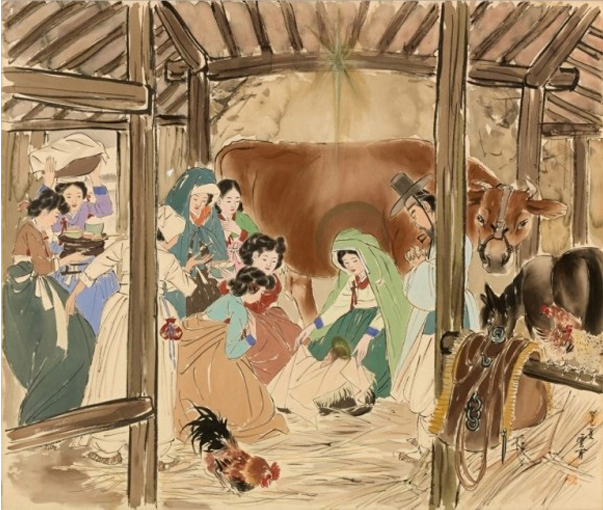
Figure 1. The Birth of Jesus
As the narrative shifts to Jesus’ public ministry, Kim establishes a consistent visual identity for Christ: the seonbi (scholar-sage). Wearing the white dopo (robe) and gat (hat), Jesus moves through the landscape with the composed gravity of a teacher.
This section is characterized by a dialogue between high culture and folk motifs. A striking example of this is The Temptation by Satan (Figure 2). Set against the rugged, steep cliffs of the Korean mountains, Jesus faces a tempter depicted as a dokkaebi (Korean goblin). Rather than a winged Western demon, this entity carries a traditional wooden club and possesses the grotesque yet mischievous features of Korean folklore. Similarly, in The Baptism by John and The Ascension, Kim replaces Western cherubs with seonnyeo (celestial maidens) whose fluttering robes and traditional instruments create a rhythmic, ethereal atmosphere. These figures function as visual bridges, translating supernatural occurrences into the aesthetic vernacular of Korean mythology.
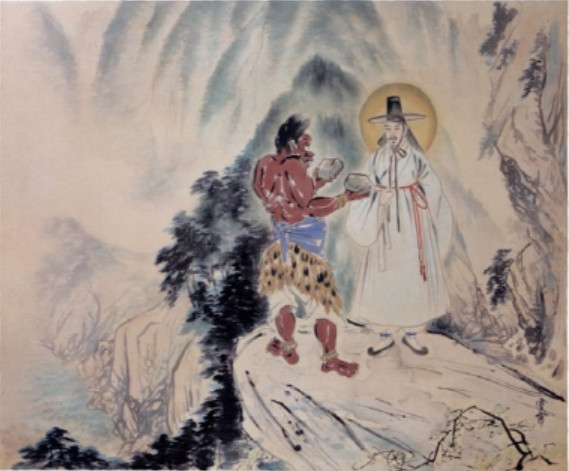
Figure 2. The Temptation by Satan
In the third movement, which chronicles the passion and death of Jesus, Kim utilizes the architecture of Hanyang (old Seoul) to heighten the dramatic tension. In The Entrance into Jerusalem, the imposing stone fortifications and city gates replace the walls of Jerusalem, situating Jesus’ arrival within the heart of the Korean capital.
A most visceral localization occurs in The Trial of Jesus and The Passion. The judicial setting of The Trial of Jesus (Figure 3) is transformed into a Joseon court, where Jesus stands before authorities in formal munmu-baekgwan (civil and military officials) attire. In The Passion, Kim replaces the biblical purple robe with a more culturally resonant image of humiliation: Jesus is bound to a hyeong-teul (traditional Korean torture frame) with his hair undone, reflecting the extreme social shame associated with criminality in the Joseon era. This movement concludes with The Disciples Carrying the Body, where the followers are clad in sangbok (white mourning clothes). The composition follows the solemn choreography of a traditional Korean burial procession (ungu), anchoring the death of Christ in the specific funerary rites of the Korean people.
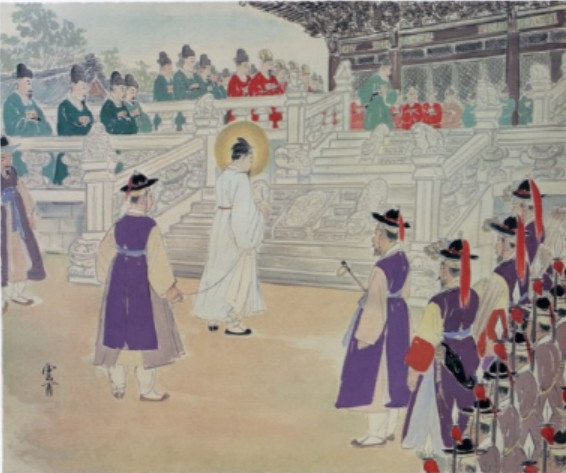
Figure 3. The Trial of Jesus
The final movement, the Resurrection and Ascension, marks a shift from historical detail to cosmic transcendence. Kim utilizes the traditional technique of yeobaek (white space) to emphasize the spiritual weight of the void. In The Resurrection (Figure 4), the conquered tomb is depicted as a massive, dark rock that contrasts with the radiating aura of the risen Christ.
The series culminates in The Ascension, where Kim employs a shifting perspective—a hallmark of East Asian landscape painting technique—to guide the viewer’s eye from the grieving disciples on the ground to the ascending figure bathed in celestial light. The use of sumuk (ink wash) to create mist-shrouded mountains suggests a dissolving of physical reality into the spiritual realm. Through these techniques, Kim concludes his narrative by illustrating that the Christ who lived and suffered as a Korean finally transcends his localized form to reach a state of universal, divine light.
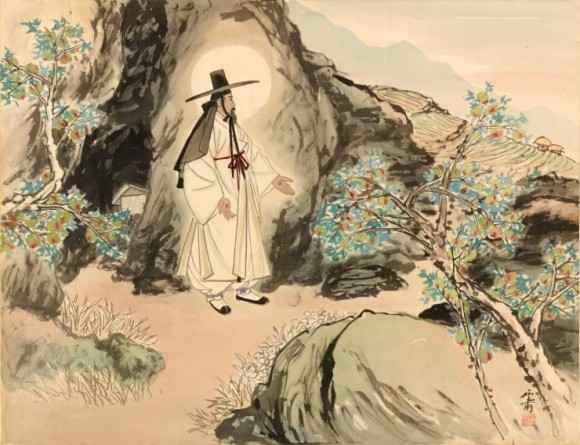
Figure 4. The Resurrection
Building upon the biographical and descriptive foundation in the previous section, this study moves beyond the analysis of Kim’s life and works to engage in a theological interpretation. By bridging the gap between Kim’s intuitive brushwork and systematic theological discourse, the following analysis investigates how the universal message of Christ was reborn within the particularities of the Korean context.
To substantiate the claim that this series functioned as a precursive theological manifestation, this study develops a multi-layered analysis across three critical dimensions. First, this paper examines the socio-cultural layer, focusing on how the 18th-century Joseon setting effectively roots the figure of the Messiah within the Korean identity. Second, it investigates the historical and existential layer by contextualizing the work within the trauma of the Korean War, revealing a “Refugee Messiah” who intimately shares in the nation’s collective suffering. Finally, this study demonstrates how the series synthesizes Confucian, Buddhist, and Shamanic elements, serving as an undifferentiated visual archetype for the indigenization theologies later formalized by theologians such as Sung-bum Yoon and Tong-shik Ryu.
The most prominent feature of the series The Life of Jesus is that it sets the life of Jesus against the backdrop of the Joseon Dynasty. These paintings—depicting Jesus wearing a gat (traditional hat) and a durumagi (overcoat), alongside figures in Joseon-era attire and traditional Korean houses such as choga (thatched-roof houses) and giwa-jib (tiled-roof houses)—even go so far as to evoke the distinctive aesthetic of the genre paintings (pungsok-hwa) of the Joseon period.13 In particular, works such as The Birth of Jesus, The Adoration of the Magi, The Flight into Egypt, Meeting the Disciples, Blessing the Children, The Woman Washing Jesus’ Feet, Let Him Who is Without Sin Cast the First Stone, The Entry into Jerusalem, The Last Supper, The Prayer in the Garden of Gethsemane, The Trial, and Meeting Mary Magdalene are deeply imbued with the characteristics of Joseon genre painting.14 Mystical elements, typical of traditional religious iconography, are absent; instead, the series appears to record the daily lives of both the nobility and commoners of the Joseon Dynasty—an aesthetic that most Koreans would instinctively associate with the works of Kim Hong-do (1745-1806), the preeminent master of Joseon genre painting.
This approach allowed Kim’s work to be evaluated as a deliberate attempt at the indigenization of Korean Christianity. By using traditional Korean painting techniques to express his interpretation of the biblical text, he ensured that sacred art—previously perceived as an exclusively Western genre—could evoke profound empathy among Korean Christians. According to Jin-myung Kim, Kim Ki-chang perceived Jesus not as a Messiah of a distant, foreign religion, but as “an indigenized reality existing among us and a practical Savior of this land.”15 Similarly, Youngok Sim evaluates Kim’s reinterpretation of the Gospel tradition—portraying Jesus as a Korean in hanbok—as a “theological attempt to indigenized Christianity.16”
Jin-myung Kim presents this original, indigenized understanding of Christianity more closely through the example of the seventh work in the series, The Baptism by John (Figure 5). He notes that while Western paintings traditionally depict the Holy Spirit’s presence in the form of a dove,17 Kim Ki-chang boldly omitted this conventional symbol. Instead, the artist visualized the heavenly sounds through rays of celestial light and the musical performances of seonnyeo (traditional Korean celestial maidens).18 Jin-myung Kim further observes that these angelic figures recall the bicheonsang (flying celestial deities) engraved on the Divine Bell of King Seongdeok, playing instruments that are also distinctly Korean.19
Furthermore, Kim’s works incorporate various elements of Korean wit and humor. For instance, in The Temptation by Satan, the devil is depicted as a mischievous dokkaebi (goblin) attempting to set a snare. In The Samaritan Woman, Jesus maintains a respectful distance from the woman, reflecting the social etiquette of the “Country of Eastern Decorum.” In The Parable of the Prodigal Son, a mother who is absent from the biblical text appears, making these solemn sacred works feel familiar and accessible to Koreans.20
As such, this biography of Jesus, rendered with unique techniques unseen in the sacred art of any other nation, holds incomparable value as a Korean sacred painting that manifests the indigenization of Korean Christianity. Unlike the works of many prominent artists produced to date, this series reinterprets the Gospels to suit Korean sentiments and expresses figures and subjects in an authentic Korean style against the backdrop of the Joseon Dynasty.
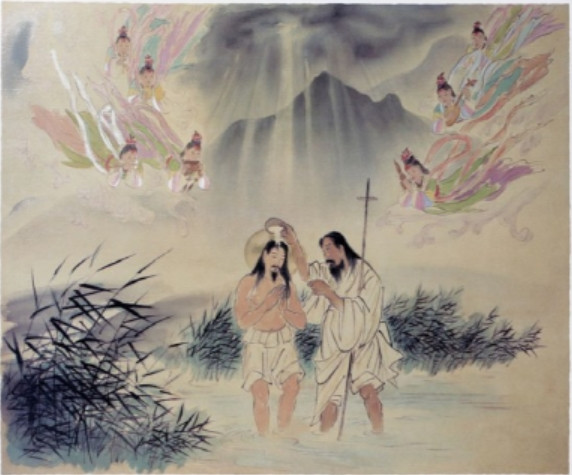
Figure 5. The Baptism by John
“While enduring my own hardships at my wife’s family home in Gunsan, I used my brush to soothe my suffering, praying fervently for the war to end and for a unified peace to return to this land… Through The Life of Jesus, I sought to bring the Gospel into direct contact with the self-experience of the Korean people.”21
This confession highlights how Kim’s Christian faith engaged in a direct dialogue with the reality of the Korean War. As a refugee himself in Gunsan, Kim was a participant-sufferer who experienced the fragmentation of life firsthand. His autobiographical struggle birthed the unique theological archetype of the “Refugee Messiah.” This sense of solidarity in suffering is most directly manifested in The Flight into Egypt (Figure 6). According to Jin-myung Kim, the poignant emotion of the refugee is palpable in this piece because the depiction of Joseph and his family serves as a direct projection of both the artist’s personal experience and the collective suffering of the Korean people.22 He also contends that the exhaustion etched on Joseph’s face is not confined to the scriptural narrative; rather, it encapsulates the fatigue of Korean fathers who struggled to protect their families through the gunfire of the Korean War.23 Viewed through this lens, Joseph becomes a symbolic mirror for every displaced citizen of the time, transforming a universal biblical theme into a specific record of the Korean people’s historical trauma. Furthermore, Kim observes that the narrative focus of the painting shifts from the literal biblical geography of “Egypt” to the universal, existential state of “flight.”24 This paper contends that by interweaving the collective suffering of war with the canonical life of Christ, Kim achieved a pivotal theological breakthrough: he invited Jesus into the very epicenter of Korean sorrow, allowing the divine to inhabit the nation’s deepest wounds. Consequently, the viewer encounters a Holy Family that is no longer a distant historical abstraction, but a fellow displaced family—pushed to the brink and struggling for survival in solidarity with the Korean people. However, a balanced theological evaluation must confront the artist’s historical transgressions. Viewing Kim solely as a co-sufferer risks oversimplifying the complex and often compromised reality of the artist himself. As previously noted, Kim had collaborated with the Japanese colonial authorities through his artistic activities. This poses a striking paradox: the very artist who visually incarnated the “indigenization of suffering” to comfort a traumatized nation had previously collaborated with the regime that oppressed it. This historical contradiction cannot be easily bracketed. If The Life of Jesus is to be truly understood within the context of Korean suffering, the artist’s history as a collaborator must be held in tension with his later role as a visual comforter. Yet, rather than invalidating the theological significance of the work, this complicity adds a layer of profound ambivalence to the series. It suggests that The Life of Jesus might function not only as an expression of collective suffering but also, perhaps unconsciously, as an act of psychological and religious penance for his own historical sins against the Korean people. Ultimately, despite the shadow of his colonial collaboration, this series transcend mere visual adaptation to stand as a definitive testament to the indigenization of suffering within the crucible of the Korean War. By projecting the life of Christ onto the national trauma of the 1950s, Kim allows the Gospel to resonate with the existential reality of a war-torn people. Depicting a Messiah who bears the collective weight of the nation’s tragedy, he achieved an unparalleled synthesis of personal penance and social solidarity, securing the series as an enduring landmark in the global history of sacred art.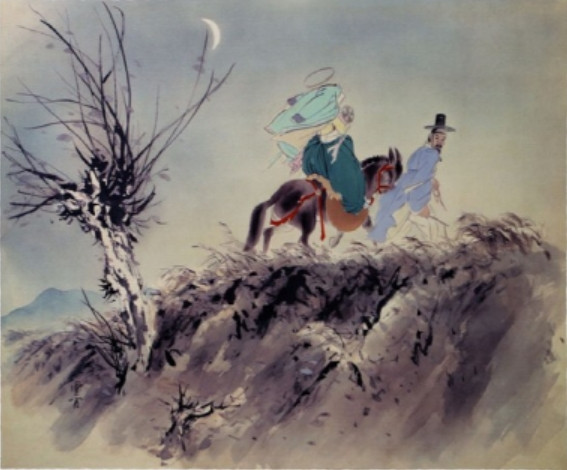
Figure 6. The Flight into Egypt
This paper identifies the final dimension of Kim’s work as the theological layer, where the Christian Gospel encounters the “Three Teachings” (Confucianism, Buddhism, and Taoism/ Shamanism) that form the bedrock of the Korean religious psyche. It is a recognized consensus in Korean academic circles that while the ideological soil for this encounter was prepared as early as the 1920s by the seminal thought of Young-mo Yoo whose philosophical integration of East Asian thought provided the intellectual root for a Koreanized faith—the theology of indigenization, representing the formal encounter between Christianity and Korean religious culture, began to be earnestly pursued in the 1960s.25 From 1960 onwards, these latent religious elements were systematically categorized by key theologians: Sung-bum Yoon established the “Theology of Sung (sincerity)” in 1961, viewing Jesus as the ultimate Confucian “Filial Son.” Tong-shik Ryu formulated the “Theology of Pungryu” in 1965, synthesizing Shamanic and Taoist rhythms to explain the Korean encounter with the Divine. Adding to this theological landscape, Seon-hwan Byeon explored the Buddhist understanding of Christianity, pioneering interreligious dialogue by seeking to harmonize the Christian message of salvation with the Buddhist concepts of emptiness and compassion in 1975.26
However, this paper contends that long before the formal codification of these academic discourses, Kim’s work from the early 1950s—forged in the existential crucible of the Korean War—had already manifested these theological elements in an undifferentiated, archetypal form. Kim translated abstract concepts into a comprehensive, lived narrative. Beyond a mere cultural translation, this theological layer represents an intuitive, embodied realization of indigenization that preceded formal theological discourse by a full decade. In Kim’s brushwork, the biblical narrative is not just clothed in Korean attire; it is reimagined through indigenous sensibilities, functioning as a vital visual precursor to what would later become the central movement of Korean indigenization theology.
In this sense, Kim’s paintings constitute a raw theological synthesis that anticipated the future of Korean Christianity. While this layer is primarily anchored in a Confucian social framework, it simultaneously harbors the seeds of Shamanic mysticism and Buddhist tranquility within a single frame. More specifically, even before the formalization of indigenization as a structured academic discipline, Kim had already visualized a holistic Korean faith where the seonbi Christ (Confucianism) interacts with seonnyeo (Taoist/Shamanic celestial beings) and eventually dissolves into a profound “void” (Buddhism). Consequently, the theological layer of this series stands as a primary text, capturing the nascent, undifferentiated archetype of the Koreanized Gospel at least 10 years before it was parsed into formal, differentiated theological categories.
Kim’s visual narrative in The Life of Jesus is primarily anchored in a Confucian-centered worldview, prefiguring the theological essence of Sung (sincerity). Consequently, a stark existential dissonance is identified within Kim’s brushwork: while the historical Jesus was a member of the minjung (common people) from the impoverished rurality of Galilee under the Roman Empire, Kim’s paintings deliberately transpose him into the highest social strata of Joseon. In Kim’s reimagining, Jesus is not a marginalized laborer but a figure predominantly garbed in the refined attire of the yangban (aristocracy). This stylistic choice inherently reflects the male-centered, class-conscious, and patriarchal hierarchy of Joseon society, which Kim utilized as his primary cultural lens. By depicting Jesus as a seonbi (literati scholar), Kim moved beyond mere historical illustration; he reconstructed the divine through the elitism of the Joseon literati, who occupied the center of the moral and social universe of the time. Ultimately, this Confucian-centered representation serves as the visual bedrock of Kim’s indigenization, where the dignity of the Gospel is equated with the moral authority of the Korean scholar-elite.
This elitist orientation is most visible starting with the eighth painting, The Temptation by Satan, where Jesus is depicted wearing the formal white dopo (robe) and gat (hat) of a Joseon scholar-sage. As Chisun Song observes, this visual strategy effectively elevates Jesus from a humble laborer to the quintessential son of a noble family, endowed with the highest social standing.27 According to Song, a remarkable visual shift further reinforces this aristocratization within the portrayal of the twelve disciples. In the ninth painting, The Calling of the Disciples, the followers are initially shown in simple, narrow-sleeved garments without headgear, reflecting their humble origins. However, following their encounter with Jesus, they undergo a transformation into aristocrats in subsequent scenes.28
Building upon Song’s identification of this sartorial transition, this paper argues that Kim intentionally utilized these elite clothing styles to re-contextualize the biblical narrative. By doing so, Kim did not merely illustrate the Gospels; he established Jesus and his followers as members of the Joseon literati, anchoring his work in the visual language of the ruling class. This paper further contends that this visual strategy is deeply intertwined with the “Theology of Sung” proposed by Sung-bum Yoon, a pioneer of Korean indigenization theology. Yoon argued that the primary cultural vessel for the Gospel in Korea was the Confucian tradition, interpreting Jesus as the “Filial Son” who perfectly embodies Sung (sincerity/integrity).29 In the Korean psyche, the seonbi represents the ultimate human ideal of moral integrity and cosmic harmony. By persistently depicting Jesus as a seonbi, Kim translated the biblical concept of “Divine Holiness” into the Korean concept of “Confucian Sincerity.” He likely believed that the figure of the Confucian scholar-sage was the most fitting representation to command moral authority within the Korean social imaginary of his time.
While this portrayal invites criticism for reinforcing androcentric hierarchies and obscuring the minjung nature of the historical Jesus, this paper views it as a necessary price of inculturation. The seonbi or yangban Jesus portrayed by Kim should be understood as a product of a psychological drive to represent the Divine in the most precious and virtuous form available within his own culture. It would be reductive to view this merely as Kim’s attempt to reproduce elitism for its own sake; rather, it may be understood as a transposition of divine authority into the most elevated cultural language available to the Korean psyche, thereby allowing the Gospel to take root in the soil of traditional moral consciousness. To make Christ a credible and dignified figure in the eyes of a society rooted in Confucian values, he had to be clothed in the garments of the highest ethical class. Thus, Kim’s work serves as a precursive visualization of Yoon’s indigenization theology, presenting a comprehensive cultural embodiment that allowed the Gospel to occupy the center of Korean moral authority by accepting the social framework of the Joseon legacy in its entirety.
In addition to the Confucian structure, Kim incorporates specific Shamanic, Taoist, and Buddhist elements to ground the supernatural narrative within the Korean religious psyche. This indigenous spiritual worldview is most vividly expressed through his reimagining of celestial and demonic beings. For instance, in The Temptation by Satan, as previously noted, the devil is depicted not as a Western demon, but as a dokkaebi (Korean goblin) wielding a traditional spiked club. Similarly, in scenes such as the The Baptism by John and The Ascension, angels are rendered as seonnyeo (celestial maidens)—beings drawn from the Korean celestial imagination rather than Western cherubs.
This paper contends that these figures serve as visual bridges, allowing Korean viewers to encounter the Gospel through familiar, indigenous archetypes. By utilizing the dokkaebi and seonnyeo, Kim’s work functions as a visual medium through which Christ’s authority can be perceived not as a foreign imposition, but as an act of indwelling within the native spiritual landscape. In this context, the divine presence is manifested through the familiar rhythms of Korean folk-belief, suggesting a mode of reception where the Gospel is no longer seen as an alien doctrine but as a reality already resonant with the indigenous psyche. This artistic intuition effectively prefigures the formal discourses of Korean indigenization theology: specifically, the “Theology of Pungryu” by Tong-shik Ryu, which emphasizes the spiritual rhythm of the Korean soul, as well as the religious pluralism of Seon-hwan Byeon, which seeks an authentic engagement with local religious realities.30 In Kim’s brushwork, the spiritual battle and heavenly celebration unfold within the collective folk-memories of the Korean people. Through this integrated lens, Kim’s work anticipates a Cosmic Christ who dwells naturally within the traditional rhythms of Korean spirituality—presenting a holistic theological synthesis long before it was parsed into distinct academic categories.
Beyond these folk elements, the series also explores the metaphysical depth of the gong (void), a concept central to both Buddhist and Taoist thought and a key theme in the earlier philosophy of Young-mo Yoo. In The Ascension, the vast, empty sky and distant, mist-shrouded mountains transcend the mere technical application of yeobaek (white space); they can be understood to represent the “heavenly Father’s home”—the gong where physical reality dissolves into the spiritual “Source of all being.” Thus, this study interprets this intentional use of space as suggesting that the ultimate destination of the Messiah is a return to the infinite, unmanifested Source.
In summary, Kim’s visual transposition of the biblical narrative served as the catalyst that allowed the Gospel to find its indigenous pulse within the Korean spiritual landscape. By weaving together the ethical rigor of Confucianism, the spiritual vitality of Shamanism, and the metaphysical tranquility of Buddhism, Kim demonstrated that the universal message of Christ could be re-rooted in the specific cultural and religious soil of Korea. The series thus stands as a nascent archetype of a Koreanized faith, where the divine no longer feels like an alien imposition but an internal realization. By establishing this multi-layered spiritual bedrock, Kim provided the essential root for what would later become the formal tradition of Korean indigenization theology, suggesting that the visceral, embodied medium of art often captures the pre-reflective essence of an indigenous faith, awaiting and inviting the systematic clarity that only the theological discipline can provide.
Yaroslav Pelikan once said, “The Jesus of Nazareth may have been a provincial, but Jesus Christ is the Man Who Belongs to the World. … His name has come to be known “unto the uttermost part of the earth.”31 When this “One who belongs to the world” arrived on the Korean Peninsula, he donned a new, indigenous robe—the dopo and gat—through Kim ’s The Life of Jesus. This paper has argued that Kim’s masterpiece is not a mere imitation of Western icons, but a creative assimilation of a foreign religion into the Korean soul. By situating the Gospel within Joseon landscapes and social structures, Kim demonstrated that Korean Christianity did not blindly adopt Western doctrine but actively reimagined it through its own historical and cultural agency.
To be specific, the theological significance of Kim’s work is identified through three interconnected layers of indigenization. On the socio-cultural layer, Kim transitioned Jesus from a foreign deity into a resident of Korean customs and traditions. Although this necessitated what may be termed a price of inculturation—the depiction of an aristocratic Jesus that reflected the elitism and androcentrism of the era—it served as a vital strategic step to secure moral and ethical authority for the Gospel within the Korean social imaginary. On the historical-existential layer, Kim’s Christ emerged as a Refugee Messiah forged in the crucible of the Korean War. While this theology of divine solidarity in suffering bears the weight of the artist’s own historical transgression, it profoundly captures the fractured reality of modern Korea, visualizing the Holy Family’s plight on the piran-gil (refugee path). On the theological layer, the series represents an undifferentiated visual archetype of the “Three Teachings” (Confucianism, Buddhism, and Shamanism). A full decade before the formalization of indigenization theology in the 1960s, Kim’s brush had already synthesized the Confucian seonbi Christ with Taoist/Shamanic seonnyeo and the Buddhist metaphysics of the gong.
Ultimately, Kim’s work demonstrates the idea that artistic practice often precedes and informs theological reflection. Kim did not find the face of a Korean Savior in a library of Western texts, but in the refugee camps where a suffering Christ met a suffering nation. His Jesus is not a foreign savior detached from historical suffering, but an indigenous companion who transforms reality from within, clothed in the white robes of the Korean people. As Pelikan suggested, the universal Christ finally found his true home in Korea—not as a stranger, but as a neighbor and a fellow traveler—through Kim’s indigenized vision.
Choi, Byeong-sik. A Study on the Art Theory of Woonbo Kim Ki-chang. Seoul: Dongmunseon, 1999.
Choi, Byeong-sik. A Fool Who Became a Natural Monument. Seoul: Dongmunseon, 1999.
Kim, Jin-myung. “A Study on the Aesthetic Biblical Interpretation of Hosea 11:1-4 and Matthew 2:13-15 – Using the understanding and interpretation of “Egypt” in the works of Unbo Kim Ki-chang and Rembrandt” in Korea Presbyterian Journal of Theology 52(2) (2020).
Kim, Jin-myung. “An Aesthetic Biblical Interpretation on – A Study of Unbo Kim Ki-Chang’s and Relating Texts (Matt. 3:3-17, Lev. 8:6, 12)” in The Korean Journal of Old Testament Studies 80 (2021).
Kim, Jin-myung. “Aesthetic Biblical Interpretation on Unbo Kim Ki-chang’s and its Biblical Texts – Focusing on Matthew 14:22-33, Exodus 3:14 and Psalm 2:7 –” in The Korean Literature and Arts 39 (2021.9).
Kim, Ki-chang. My Love and Art. Seoul: Jeongwoo Publishing, 1977.
Kim, Ki-chang. The Life of Jesus: Collection of Sacred Painting by Kim Ki-chang. Seoul: Kyung-mi Publishing, 1980.
Kim, Mi-ri. “Conceiving Jesus in a Jeogori… The Mary of Joseon,” Chosun Ilbo, January 28, 2014, https://art.chosun.com/site/data/html_dir/2014/01/28/2014012800291.html.
Lee, Jung-bae. A Study on the Vanguard Indigenization Theology of Korean Protestantism. Seoul: Christian Literature Society of Korea, 2003.
Lim, Ga-yeon. “A Study of Sacred Art in Korean Paintings: Focusing on Idang and Woonbo.” Master’s thesis, Kyonggi University, 2007.
Park, Hyeon-ju. “‘Jesus in a Gat and Hanbok…’: Kim Ki-chang’s ‘The Life of Jesus’ Becomes a Sensation in Germany.” Newsis, April 13, 2017, https://www.newsis.com/view/?id=NISX20170413_0014828721&cID=10701&pID=10700.
Pelikan, Yaroslav. Jesus Through the Centuries: His Place in the History of Culture. New York: Perennial Library, 1987.
Sim, Youngok. “The Contextualization of Christianity Through the Paintings on Jesus’ Life by Kim, Ki-chang.” Theology and Other Disciplines. 22(3) (2020).
Song, Chisun. “A Study on Unbo Kim Ki-chang’s Korean Jesus and Korean Male Chauvinistic Elitism in The Life of Jesus Considered by Michael Baxandall’s Period Eye Theory” in Theological Forum 104 (2021.6).
Song, Myung-cheol. “The necessary and sufficient conditions to inculturated theology.” Journal of Humanities 56 (2018).
The Compilation Committee of the Dictionary of Pro-Japanese Collaborators. Dictionary of Pro-Japanese Collaborators. Seoul: The Center for Historical Truth and Justice, 2009.
Woonbo Kim Ki-chang’s 80th Birthday Commemorative Catalogue and Exhibition Planning Committee. Woonbo Kim Ki-chang, vol. 4. Seoul: AP International, 1994.
1 See Ga-yeon Lim, “A Study of Sacred Art in Korean Paintings: Focusing on Idang and Woonbo” (master’s thesis, Kyonggi University, 2007); Hong-mi Han, “A Study on Korean Modern and Contemporary Religious Paintings-Focusing on Unbo Kim Gichang-” (master’s thesis, Hongik University, 2009); and Seong-ju Hyun, “A Study of the Theo-Aesthetic Implications of Visual Symbolization of Jesus Christ” (Ph.D. diss., Baekseok University, 2014).
2 See Chisun Song, “A Study on Unbo Kim Ki-chang’s Korean Jesus and Korean Male Chauvinistic Elitism in The Life of Jesus Considered by Michael Baxandall’s Period Eye Theory,” Theological Forum 104 (June 2021); Shin Ahn, “Religious Education Encounters the Arts in World Christianity: Focusing on Unbo Kim Kichang’s Life of Jesus (1952),” Korean Journal of Religious Education 58 (2018); and Youngok Sim, “The Contextualization of Christianity Through the Paintings on Jesus’ Life by Kim, Ki-chang,” Theology and Other Disciplines 22, no. 3 (2020).
3 Regarding the aesthetic biblical exegesis of specific paintings, see Jin-myung Kim, “A Study on the Aesthetic Biblical Interpretation of Hosea 11:1-4 and Matthew 2:13-15: Using the Understanding and Interpretation of ‘Egypt’ in the Works of Unbo Kim Ki-chang and Rembrandt,” Korea Presbyterian Journal of Theology 52, no. 2 (June 2020); “An Aesthetic Biblical Interpretation on ‘Baptism of Christ’: A Study of Unbo Kim Ki-Chang’s ‘Baptized by John’ and Relating Texts (Matt. 3:3-17, Lev. 8:6, 12),” The Korean Journal of Old Testament Studies 80 (2021); and “Aesthetic Biblical Interpretation on Unbo Kim Ki-chang’s ‘Walking on Water’ and its Biblical Texts: Focusing on Matthew 14:22-33, Exodus 3:14 and Psalm 2:7,” The Korean Literature and Arts 39 (September 2021).
4 Kim Ki-chang, “The Life of Jesus in a Horsehair Hat into Which I Have Put My Heart,” in The Life of Jesus: Collection of Sacred Paintings by Kim Ki-chang (Seoul: Kyung-mi Publishing, 1980), 10.
5 The Dictionary of Pro-Japanese Collaborators identifies Kim Ki-chang’s participation in pro-Japanese art organizations and his creation of three specific cases of artwork as evidence of collaboration: Heeding the Call of the Lord (1943), Soldier in the Rear (1944), and Close Combat with the Enemy (1944). See The Compilation Committee of the Dictionary of Pro-Japanese Collaborators, Dictionary of Pro-Japanese Collaborators (Seoul: The Center for Historical Truth and Justice, 2009), 280-281.
6 Byeong-sik Choi, A Study on the Art Theory of Woonbo Kim Ki-chang (Seoul: Dongmunseon, 1999), 67-68.
7 Woonbo Kim Ki-chang’s 80th Birthday Commemorative Catalogue and Exhibition Planning Committee, Woonbo Kim Ki-chang, vol. 4 (Seoul: AP International, 1994), 43.
8 Mi-ri Kim, “Conceiving Jesus in a Jeogori… The Mary of Joseon,” Chosun Ilbo, January 28, 2014, https://art.chosun.com/site/data/html_dir/2014/01/28/2014012800291.html. See also Byeong-sik Choi, A Fool Who Became a Natural Monument (Seoul: Dongmunseon, 1999), 171–172.
9 Kim Ki-chang, My Love and Art (Seoul: Jeongwoosa, 1977), 172. See also Bong-nam Seo, History of Christian Art (Seoul: Dongmunseon, 1994), 274.
10 Byeong-sik Choi, A Study on the Art Theory of Woonbo Kim Ki-chang, 70-71, 73.
11 Youngok Sim, “The Contextualization of Christianity Through the Paintings on Jesus’ Life by Kim, Ki-chang,” Theology and Other Disciplines 22, no. 3 (2020), 54. Sim further expresses regret that Kim’s monumental artistic achievements are increasingly overshadowed or disparaged due to this pro-Japanese record. Ibid., 59.
12 Hyeon-ju Park, “‘Jesus in a Gat and Hanbok…’: Kim Ki-chang’s ‘The Life of Jesus’ Becomes a Sensation in Germany,” Newsis, April 13, 2017, https://www.newsis.com/view/?id=NISX20170413_0014828721&cID=10701&pID=10700.
13 Sim, “The Contextualization of Christianity Through the Paintings on Jesus’ Life by Kim, Ki-chang,” 41.
14 Ga-yeon Lim, “A Study of Sacred Art in Korean Paintings: Focusing on Idang and Woonbo” (master’s thesis, Kyonggi University, 2007), 31.
15 Jin-myung Kim, “Aesthetic Biblical Interpretation on Unbo Kim Ki-chang’s and its Biblical Texts – Focusing on Matthew 14:22-33, Exodus 3:14 and Psalm 2:7 –,” 273.
16 Sim, “The Contextualization of Christianity Through the Paintings on Jesus’ Life by Kim, Ki-chang,” 59.
17 Jin-myung Kim, “An Aesthetic Biblical Interpretation on – A Study of Unbo Kim Ki-Chang’s and Relating Texts (Matt. 3:3-17, Lev. 8:6, 12)” in The Korean Journal of Old Testament Studies 80(2021), 181.
18 Ibid., 185-186.
19 Ibid., 183.
20 Sim, “The Contextualization of Christianity Through the Paintings on Jesus’ Life by Kim, Ki-chang,” 57.
21 Kim Ki-chang, The Life of Jesus, 10–11.
22 Jin-myung Kim, “A Study on the Aesthetic Biblical Interpretation of Hosea 11:1-4 and Matthew 2:13-15 – Using the understanding and interpretation of “Egypt” in the works of Unbo Kim Ki-chang and Rembrandt” in Korea Presbyterian Journal of Theology 52(2) (2020), 15.
23 Ibid., 15-16.
24 Ibid., 16.
25 Myung-cheol Song, “The necessary and sufficient conditions to inculturated theology,” Journal of Humanities 56 (2018), 240.
26 Ibid., 241-242.
27 Chisun Song, “A Study on Unbo Kim Ki-chang’s Korean Jesus and Korean Male Chauvinistic Elitism in The Life of Jesus Considered by Michael Baxandall’s Period Eye Theory,” 222.
28 Ibid., 225.
29 For Sung-bum Yoon’s Confucian indigenization theology, see Jung-bae Lee, A Study on the Vanguard Indigenization Theology of Korean Protestantism (Seoul: Christian Literature Society of Korea, 2003), 131–168.
30 For Seon-hwan Byeon’s theocentric indigenization theology and Tong-shik Ryu’s Theology of Pungryu, see Jung-bae Lee, A Study on the Vanguard Indigenization Theology of Korean Protestantism, 169-199 and 200-224, respectively.
31 Yaroslav Pelikan, Jesus Through the Centuries: His Place in the History of Culture (New York: Perennial Library, 1987), 221.